
Stephen was terminally ill, and he told Katie and Brooke 7 SHOCKING WORDS The Bold and the Beautiful
Los Angeles’ fashion elite were blindsided this week on The Bold and the Beautiful as the Logan sisters faced a moment that would forever redefine family, loyalty, and ambition. In the midst of a searing corporate showdown over Hope Logan’s secret defection to Logan Designs, the chaos was abruptly interrupted by a life-altering revelation: Stephen Logan, the formidable patriarch of the Logan dynasty, had entered the room looking frail, haggard, and visibly worn, collapsing before his daughters in a moment of heartbreaking immediacy.
Katie and Brooke’s argument, which had escalated into a full-blown screaming match over contracts, contracts stolen designs, and generational power, was immediately silenced. The sight of their father crumpled on the floor reduced both sisters to near paralysis, instantly reminding them of the fragility of life and the insignificance of even their most heated rivalries in the face of mortality. The flashing panic in their eyes, the frantic calls for emergency help, and the raw terror that rippled through the office captured a scene of pure human vulnerability that even years of soap opera drama had not prepared viewers to witness.
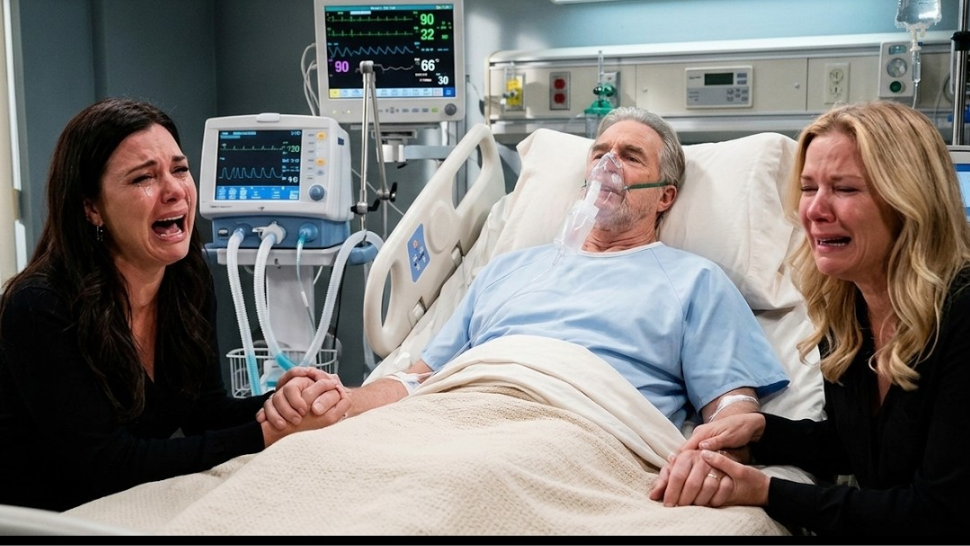
Rushed to the hospital, the gravity of the situation became unmistakable. Stephen Logan, a man who had often been a distant and unpredictable figure in his daughters’ lives, delivered devastating news: he was terminally ill. The word “terminal” hung in the air like a guillotine, instantly shifting the stakes of every personal and professional conflict. In a whisper that carried more weight than any corporate maneuver, Stephen spoke the seven words that would redefine the Logan family’s trajectory: “Family is the only legacy that matters.” Those words were both a plea and a command, urging Katie and Brooke to abandon the pettiness and power struggles that had dominated their lives, to reconcile before it was too late.

Brooke Logan’s reaction was complex and layered. She was still reeling from the shock of Hope’s betrayal, furious at the realization that her daughter had orchestrated a secret career move, seemingly undermining her own efforts at Forrester Creations. Her emotions oscillated between anger and profound grief, forcing her to confront her longstanding obsession with control and perfection. The hospital scene became a crucible, melting away corporate pretense and exposing the raw vulnerability beneath Brooke’s polished exterior. Here, the show reminded viewers that even the fiercest of personalities can be humbled by the impermanence of life.
Katie Logan, whose pragmatism often defined her interactions with family and business alike, was equally affected. Seeing her father in such a state stripped away the armor she had constructed over years of rivalry with Brooke. For Katie, the chaos of the fashion world—the stolen designs, the legal battles, the covert strategies—suddenly seemed trivial. In that moment, she was a daughter first, a competitor second. The emotional resonance of Stephen’s collapse allowed Katie to step back from her usual assertiveness, revealing the deep loyalty and love that had long guided her actions behind the scenes.
Meanwhile, Steffy Forrester Finnegan brought a whirlwind of unpredictability to the hospital’s tense atmosphere. True to her recent trajectory, Steffy could not process Stephen’s terminal diagnosis as a straightforward tragedy. Her mind immediately leapt to conspiracy, convinced that the illness was a manipulative tactic designed to distract Forrester Creations from the ongoing corporate war. In classic Steffy fashion, her response was a cocktail of paranoia, trauma, and obsessive protectiveness over her family’s legacy. The writers’ decision to have Steffy suspect deception in the midst of a genuine crisis heightened the tension, demonstrating the show’s mastery of blending psychological complexity with soap opera spectacle.
Finn Finnegan, caught in the crossfire between Steffy’s volatile emotions and the hospital’s grim reality, provided a stabilizing presence. As a medical professional and husband, Finn struggled to balance empathy, medical insight, and marital patience. His quiet, controlled reactions highlighted the stark contrast between Steffy’s impulsivity and the profound gravity of Stephen’s condition, amplifying the emotional stakes for the audience. Similarly, Eric Forrester, witnessing the vulnerability of the Logans’ patriarch, was forced to confront his own mortality and the futility of recent corporate machinations, providing a rare moment of introspection for the iconic character.
The revelation of Stephen’s terminal illness rippled far beyond personal grief. It instantly reframed the ongoing corporate conflicts that had gripped Los Angeles’ fashion elite. Bill Spencer, always attuned to leverage and opportunity, was likely to perceive this as a strategic moment, potentially exploiting the Logan family’s distraction to advance his own business interests. Hope Logan, caught between loyalty to her mother, her aunt, and her professional ambitions, now faced an emotional and ethical labyrinth that tested both her judgment and her moral compass. Wyatt Spencer’s return, coinciding with this crisis, added yet another layer of complexity, as he navigated his father’s ambitions, his mother’s protective instincts, and the shifting allegiances of the younger generation.
The writing cleverly juxtaposed life-and-death urgency with the high-stakes corporate drama, forcing characters and viewers alike to re-evaluate what truly matters. The hospital setting became more than a backdrop; it was a crucible in which pride, power, and rivalry were tempered by the sobering presence of mortality. For Brooke and Katie, the realization that their personal feud could not endure alongside Stephen’s limited time created an opportunity for reconciliation, however fraught and complicated.
Yet the story did not allow for easy resolution. Steffy’s suspicions, combined with lingering rivalries, created a volatile mix that promised continued tension. The unfolding dynamics suggested that while Stephen’s words called for unity, the practical realities of ambition, inheritance, and ego would ensure that conflicts remained alive, simmering just beneath the surface. The emotional complexity of this arc demonstrates why The Bold and the Beautiful continues to captivate audiences: it seamlessly intertwines personal drama with professional intrigue, creating narrative tension that is both relatable and exhilarating.
In the aftermath, the audience witnessed a remarkable transformation. The sisters, previously locked in a cycle of retaliation and ambition, were forced to confront the primacy of familial bonds over corporate conquests. Brooke, usually defined by her fierce competitiveness, showed a capacity for empathy and reflection. Katie, steadfast yet ambitious, found herself negotiating the delicate balance between business acumen and human compassion. The storyline underscored the series’ enduring theme: even in a world dominated by wealth, power, and influence, the ties of family remain the most compelling, unpredictable, and enduring force.
As the narrative unfolded, viewers were reminded that soap operas thrive on the collision of personal and professional stakes. Stephen Logan’s terminal illness served as both a narrative reset and a catalyst, realigning priorities and forcing characters into a shared emotional space. It reinforced the notion that beneath the glamour, high fashion, and corporate rivalry lies a profound exploration of human vulnerability, mortality, and the enduring need for connection.
Ultimately, this storyline elevated The Bold and the Beautiful beyond mere fashion-centric drama. It created a visceral, emotionally charged experience that resonated with audiences on multiple levels: the fragility of life, the complexity of familial love, and the transformative power of vulnerability. Stephen’s seven words—“Family is the only legacy that matters”—will reverberate through Los Angeles’ elite circles, reshaping the Logan sisters’ relationship, redefining corporate priorities, and setting the stage for a season of emotional reckoning, strategic recalibration, and unforgettable soap opera drama.
The weeks to follow promise continued fallout as Brooke and Katie grapple with their own grief while navigating professional responsibilities, Steffy wrestles with suspicion and control, and the younger generation confronts the consequences of divided loyalties. The Logan family’s story arc reminds viewers that even amidst cutthroat ambition, real human stakes always take precedence—and that sometimes, a single truth can eclipse years of conflict in a heartbeat.