
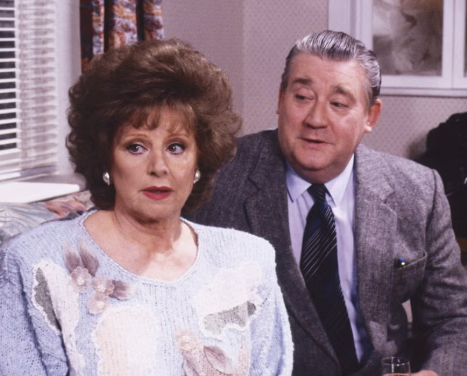
At 74, Alf Roberts Finally Revealed The Truth About Leaving Coronation Street
The rain-slicked, historic cobblestones of Weatherfield have officially borne witness to the ultimate unmasking of a television legend, as a breathtaking, high-octane retrospective on Coronation Street violently shatters twenty-seven years of institutional mythmaking by exposing the raw, heartbreaking truth behind Bryan Mosley’s definitive exit from his iconic role as Alf Roberts. For decades, the millions of loyal soap opera fans who tuned into the long-running ITV drama were securely anchored by the comfortable, conservative presence of the town’s premier grocer, local councillor, and two-time mayor, completely absorbing the character as a permanent pillar of the North-country landscape. Yet, behind the sterile logistics of his on-screen New Year’s Eve demise—where an elderly Alf was found peacefully dead in his armchair during a festive gathering at Gail Platt’s house—lay a multi-layered crucible of real-world backstage warfare and intense personal anguish that has finally been dragged into the harsh, unyielding light of day. The grand illusion that Mosley simply chose to step back into a peaceful retirement has been systematically executed by former show insiders and intimate biographies, revealing a chilling narrative of systemic pressure, broken promises, and creative execution that left the legendary performer completely hollowed out before his own tragic, real-life collapse.
The suffocating tension surrounding the actor’s forced departure rapidly morphs into a masterclass of structural daytime politics, as unredacted archival accounts and statements from prominent scriptwriters like Daran Little unshadow a dark, deeply upsetting decision spearheaded by the network’s executive hierarchy. At seventy-four years of age in the cultural timeline, the fictional memory of Alf Roberts remains a towering monument of old-school British television, but back in the chaotic winter of 1998, a team of hyper-vigilant producers decided to ruthlessly smash the giant reset button on the program’s historical lineage to chase headline-grabbing relevancy. Despite the reality that Mosley had desperately battled through severe cardiac troubles and complex diabetes, undergoing a grueling recovery block after a major 1997 heart scare to defiantly march back onto the set, the supreme decision-makers at Granada Television had secretly decided that his historic association with the street was entirely legally and emotionally toothless. Mosley went on the record to passionately protest the network’s subterranean maneuvering, fiercely shouting to national publications that he felt like a new man following a restorative religious pilgrimage to Lourdes and explicitly clarifying that he possessed absolutely zero intentions of ever quitting the show that ran natively through his very blood supply.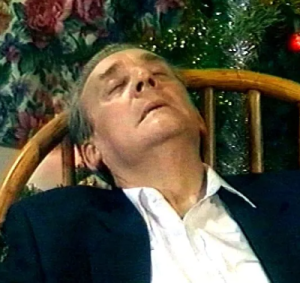
The true, stomach-dropping horror of this creative betrayal reached its absolute crescendo during the filming of Alf’s final, silent sequence, a moment defined by a claustrophobic matrix of repressed guilt and authentic tears that completely paralyzed the entire studio floor. As the cameras rolled on the heartbreaking scene where an oblivious, celebratory family network toast the dawn of 1999 while the patriarch silently slips away into the dark, the atmospheric pressure inside the set plummeted to absolute zero under the raw velocity of the cast’s collective grief. Insiders reveal that a shattered Barbara Knox stood weeping on the sidelines, entirely incapable of separating the fictional tragedy from the monstrous, real-time execution of her closest co-star’s professional lifeline by pipsqueak producers who viewed human icons as disposable chess pieces. In a stunning, defiant display of his legendary Northern wit and a primitive refusal to let the corporate machine completely crush his spirit, the moment the director screamed cut, a perfectly still Mosley suddenly sat bolt upright in the armchair and bellowed a loud, echoing boom across the frozen room, transforming a tense, suffocating silence into a wave of hysterical, cathorphic laughter that allowed him to claim the absolute final laugh over his employers.
Yet, the catastrophic fallout of this boardroom-level axing extended far beyond the sterile boundaries of the television studio, launching a tragic, real-world domino effect that would violently intercept Mosley’s life a mere six weeks after his final episode broadcasted to an audience of nineteen million spellbound viewers. Stripped of the daily structure and the protective behavioral shield that the character of Alf Roberts had provided for nearly forty years, the actor was left trapped in a dangerous, high-stakes vacuum where his internal identity was forced to survive a sudden, devastating separation from its artistic life support system. While a close circle of devoted friends desperately attempted to coordinate a fresh, independent sovereignty for his talents—planning a sequence of fulfilling travel pilgrimages to Venice alongside his childhood sweetheart, Norma, and designing a fresh marketing campaign with his talent agent—his compromised cardiovascular system remained on a permanent, hyper-sensitive hair trigger of physical exhaustion. On February 9th, 1999, directly after stepping out of a financial institution in Shipley to organize the capital for his impending holiday, Mosley suffered a massive, localized heart attack along the concrete bypass, collapsing into the dirt and dying before the emergency transport vehicle could successfully breach the perimeter of the Bradford Royal Infirmary. 
The dramatic irony of this parallel death sequence remains breathtakingly thick and profoundly haunting to a contemporary generation of soap historians, highlighting a universe where the fictional deceptions written onto a script page have a terrifying, prophetic habit of tracking down their flesh-and-blood creators in real time. The ultimate unmasking of the truth behind Alf Roberts’ departure serves as a stern, unyielding manifesto against the cold-blooded reality of institutional entertainment, proving that the currency of network survival is consistently paid for with the very souls of the legendary actors who built the empire from the ground up. As the heavy, retrospective credits roll on this newly uncovered chapter of Coronation Street history, fans across the global landscape are left to hyperventilate into the dark, completely mesmerized by the sheer magnitude of Mosley’s unvarnished fortitude and the enduring legacy of an authentic Northern giant who refused to wilt under the roaring onslaught of corporate intimidation. The historic cobblestones continue to stand as a silent witness to the fractured alliances and hidden trauma that define the daytime medium, leaving a gripped, hyper-vigilant fandom to permanently mourn the loss of a dependency, a thrift, and a trilby-hatted dignity that will never, ever be replicated in the history of the aristocracy.